

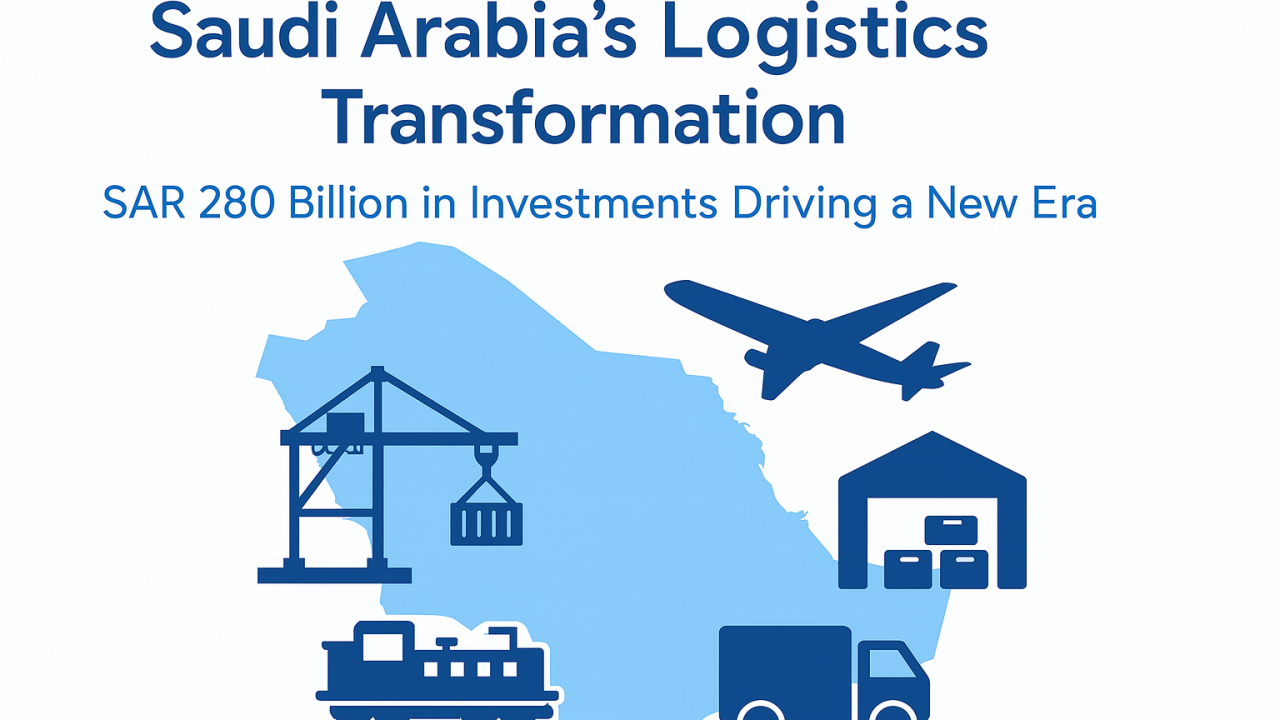
Saudi Arabia’s transport and logistics sector has entered a new era of accelerated growth. Recent reports reveal that the Kingdom has secured over SAR 280 billion (USD 74.6 billion) in private-sector investment across logistics, transport, infrastructure, and supply-chain services. This unprecedented surge signals one thing clearly:
Logistics is no longer a supporting function — it is becoming one of the core engines of Saudi Arabia’s economic transformation.
1- The Scale of Growth: What the Investment Wave Tells Us
Across both articles, several themes emerge that reflect the sector’s powerful momentum:
- SAR 280 billion invested through private-sector contracts — a record for the industry.
- 6.2% annual growth in the transportation and storage sector’s contribution to GDP — a sign of expanding economic importance.
- Air freight volumes up 34% year-on-year, surpassing 1.2 million tons — demonstrating rapid trade acceleration.
- 144,000 new jobs added in Q1 alone, representing a 28% expansion in the workforce — underscoring a more mature and professionalised ecosystem.
- Major expansions in rail procurement, port capacity, multimodal terminals, and new logistics zones — strengthening the Kingdom’s connectivity.
This is not incremental growth; this is structural, long-term transformation.
2- Why This Is Happening Now
Several forces are converging at the perfect time:
• Vision 2030 is reshaping the logistics landscape
Saudi Arabia aims to become a global logistics hub, linking three continents. Investments are aligning with this ambition through new ports, airports, rail networks, industrial cities, and special economic zones.
• Demand from manufacturing, retail, e-commerce, and import/export is surging
From consumer goods to industrial supply chains, businesses are scaling operations — and they need faster, more reliable logistics solutions.
• The private sector is stepping in with confidence
International investors, regional players, and local companies see strong economic fundamentals and stable long-term demand.
• Digital and asset-light models are rising
Companies are focusing on flexibility, integration, and visibility — making the market ripe for agile 4PL and tech-enabled operators.
3- Looking Ahead: What the Next 24 Months Will Bring
With SAR 280 billion in motion, we expect:
- Rapid expansion of multimodal logistics (air–sea–land–rail).
- Increasing demand for warehousing, cold-chain, distribution, and last-mile services.
- Accelerated adoption of digital logistics, visibility dashboards, and predictive analytics.
- Stronger Saudi–global trade corridors, increasing import/export flows.
- More reliance on agile, partner-based models rather than asset-heavy operators.
The companies that win will be those that are fast, tech-enabled, transparent, and deeply connected across the logistics ecosystem.
Rafid’s Role in Saudi Arabia’s Logistics Transformation
At Rafid Logistics, we see this moment as a call to lead — not follow.
We are building:
- A unified logistics platform that integrates warehousing, transportation, procurement, and operations.
- A high-quality partner network that accelerates scalability across Saudi Arabia.
- Data-driven tools that give clients visibility, speed, and control.
- A service model aligned with the Kingdom’s vision of a globally competitive, integrated supply-chain ecosystem.
The future of logistics in Saudi Arabia is bold, connected, and digital — and Rafid is ready to help shape it.
Final Thought
Saudi Arabia’s logistics sector is not experiencing ordinary growth — it is undergoing a historic transformation. With one of the largest investment waves the region has ever seen, the Kingdom is redefining its role in global trade.
